

Mistral has locked in a group of enterprise customers to finance its Mistral European compute buildout, disclosed on 14 August 2026, as the French scaleup moves to position itself as the region’s leading AI infrastructure provider. ASML, Amadeus, CMA-CGM, Caisse des Dépôts and Capgemini are among the anchor group making multi-year financial commitments to support the company’s plan to deploy one gigawatt of AI compute capacity across Europe by 2030.
The commitments convert into what Mistral calls European Compute Units (ECUs), a form of advance credit that gives customers access to future compute and related services as Mistral builds them out. The logic is straightforward: pooling forward demand from a group of large enterprises can, as Mistral told The Next Web, “support infrastructure in Europe at a scale no participant could secure alone.”
Which leaves an obvious question for any prospective customer: how long are you actually committed? According to The Next Web, partners sign up for around five years with no early exit, a detail confirmed by Mistral’s chief technology officer Timothée Lacroix. That is a meaningful lock-in for enterprise procurement teams used to more flexible cloud contracts.
The Mistral European compute buildout: what the 1 GW target actually means
One gigawatt of AI compute is a large number to put a price on. Mistral CEO Arthur Mensch has previously estimated that reaching that target would represent a $50 billion investment. The company is not expecting venture capital alone to cover it. Mistral is reportedly in talks to raise €3 billion at a valuation of around €20 billion, but the ECU model is clearly designed to bring in committed revenue ahead of capacity coming online, reducing the financing burden.
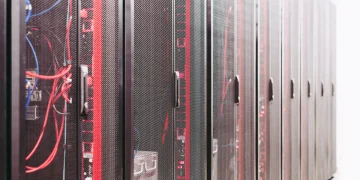
The first concrete step in the Mistral European compute buildout is a data centre south of Paris, funded by an $830 million loan, which will deliver 44 megawatts (MW) of capacity. As SaaS Rise reported, the enterprise commitments and that loan were announced together, signalling that Mistral is trying to move infrastructure and customer contracts in parallel rather than building speculatively.
To give a sense of what 1 GW would mean competitively: Dutch neocloud Nebius has said it has contracted 750 MW of compute capacity across EMEA (Europe, Middle East and Africa). If Mistral reaches its 2030 target, it would be a sizable presence in a market that is still taking shape.
ASML’s involvement carries some weight beyond a financial commitment. Christophe Fouquet, ASML’s chief, whose company led Mistral’s $13.4 billion Series C last year, said that building European AI capacity is one of the few industrial endeavours that “will matter more to Europe’s next generation,” according to VentureBeat. That framing reflects the broader anxiety in European tech circles about whether the region can build sovereign AI infrastructure before dependency on US hyperscalers becomes structural.
Less than a month before this announcement, Microsoft made a multi-billion-dollar commitment to using Mistral’s compute infrastructure in Europe, adding another large anchor customer to the mix.
Opening the platform: third-party models and data-residency controls
Alongside the infrastructure news, Mistral announced it is opening its platform to third-party open models. Customers will now be able to run workloads using models from other providers on the same infrastructure, regional controls and service commitments that Mistral applies to its own systems. The first addition is GLM-5.2, an open-weights model from Chinese AI lab Z.ai, with further models expected to follow.
Mistral also introduced a new feature letting customers choose whether their inference runs in the US or in Europe. The company said this will help users “align inference location with their data-residency, regulatory, and latency requirements,” a capability that is likely to matter most to regulated industries working under rules such as GDPR.
Mistral originally launched to develop homegrown AI models to compete with US labs like OpenAI and Anthropic. The ECU programme, the third-party model integrations and the inference-location controls all point to a company now building the full stack of what a cloud provider needs: capacity, flexibility, and the compliance tooling that enterprise buyers tend to put near the top of their requirements list. Whether the demand pledged today translates into the 1 GW target by 2030 will depend on Mistral executing a financing and construction challenge that no European AI company has attempted at this scale. The five-year lock-in from anchor customers at least means the revenue side of that equation has a floor.