

The Fractile funding round valuation has reached $6.5bn, according to Bloomberg, as the UK chip startup holds advanced talks to bring in around $600m from a new group of investors. Lightspeed Venture Partners and Redpoint are reportedly set to co-lead the round, with Thrive Capital and Founders Fund also expected to participate, according to TechTimes. The round has not closed and details could change.
Which leaves an obvious question: what does a $6.5bn valuation actually reflect when the chips haven’t shipped yet?
From $1bn to $6.5bn: the Fractile funding round valuation in context
The scale of that figure becomes clearer when you stack it against the recent history. Fractile raised $220m in May in a Series B led by Accel, Factorial Funds and Founders Fund, with additional participation from Conviction, Felicis and 8VC, according to Silicon UK. That round gave the company a post-money valuation of about $1bn. If the new round closes at $6.5bn, the company’s valuation will have increased more than six times in a matter of months.
The company was founded in 2022 by Walter Goodwin, a University of Oxford robotics specialist, and counts Peter Thiel’s Founders Fund, Accel, the Nato Innovation Fund, Kindred and Oxford Science Enterprises among its existing backers. Goodwin serves as chief executive.
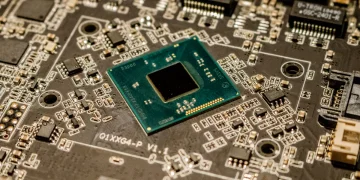
Fractile’s proposition is AI inference chips: the hardware used to run AI models once they have been trained, rather than the training process itself. It has a deal to supply US AI lab Anthropic with its chips, a relationship that has clearly caught the attention of investors. But TechTimes reports that Fractile’s chips are not expected to be ready for deployment until 2027, which means investors are, in effect, placing a large bet on silicon that does not yet exist at commercial scale.
Whether that gives investors pause is, apparently, not the immediate concern. The demand for AI inference hardware is acute enough that locking in a supply relationship early carries its own logic, even at pre-revenue, pre-deployment stage.
UK government backing and a broader European race
The Fractile funding round valuation also lands in a context that the UK government has been actively trying to shape. The government recently announced a £1.1bn AI hardware plan aimed at supporting homegrown chip companies, a policy move that reflects how seriously policymakers are treating domestic semiconductor capacity as a strategic asset.
Fractile is not alone in racing to build that capacity. Across Europe, a cluster of chip startups is chasing the same opportunity. Axelera, a Dutch startup building energy-efficient chips for AI, raised $250m in February. Olix, a UK-based AI chip company founded by 25-year-old serial founder James Dacombe, raised $312m earlier this month at a $3.3bn valuation.
The pattern is consistent: investors are prepared to commit large sums to companies that do not yet have chips in customers’ hands, on the basis that the demand for inference hardware will remain substantial enough to reward whoever gets there. The gap between valuation and shipped product is wide across the sector, not just at Fractile.
What makes the Fractile case stand out is the combination of the Anthropic relationship and the speed of the valuation jump. A sixfold increase in a few months is the kind of move that tends to attract scrutiny as much as admiration. Bloomberg’s sources describe the talks as at an advanced stage, but until the round closes, the $6.5bn figure remains exactly that: a figure in talks, not a settled fact.
With chips not expected to reach deployment until 2027, the next concrete milestone investors will be watching for is the round’s close, and whatever commitments on product timelines come attached to it.